Sponsored Content | Digital Free Press
When moving to a new place or downsizing temporarily, people might use self storage in Clarksville, TN to keep items in limbo while searching for a better living arrangement.
For many in Phoenix, the bigger question is not just where to put boxes, but how neighborhoods are built, whether homes, shops, transit, and services are close enough so that daily life doesn’t require long drives. As the Phoenix metro keeps pushing outward, it could benefit from lessons learned in peer cities that have embraced mixed-use development, higher density, and transit-oriented planning.
What Phoenix is Doing Now – Strengths & Limitations
Phoenix has made notable strides: the light rail system (Valley Metro), recent policy pushes toward Transit Oriented Communities (TOCs), and interest in denser infill along transit corridors. Mixed use developments like CityScape in downtown, or CityNorth in the northeast valley, show that demand exists for places with shopping, residences, entertainment all in closer proximity.
Yet there are limitations. Many suburbs remain designed for cars, wide arterial roads, separated housing and commercial zones, minimal walkability, and gaps in frequent transit service. Infrastructure, parking requirements, and zoning often favor low-density developments. As Phoenix continues to grow, doing more of the same risks further congestion, larger carbon emissions, and increasing cost burdens on residents.
Lessons from Other Cities & Tools Phoenix Could Use
Other growing U.S. cities have had success combining transit, density, and mixed-use design. Here are some practices and tools Phoenix could lean on, along with evidence from authority sources.
- Transit-Oriented Development (TOD) Frameworks: The U.S. Federal Transit Administration (FTA) provides guidelines and grant programs to help cities plan housing, jobs, and amenities around transit stations to reduce car dependency and increase accessibility. Phoenix could expand zoning flexibility around transit stops to allow for more mixed uses (residential, retail, offices) in the same buildings or blocks.
- Infrastructure Financing Tools: The U.S. Environmental Protection Agency (EPA) has published Infrastructure Financing Options for Transit-Oriented Development to help municipalities cover the costs of supporting infrastructure, sidewalks, transit stations, streetscape, pedestrian amenities. Cities with strong TOD use incentive programs, tax increment financing, or value capture (where increased property value around station zones helps pay for infrastructure improvements).
- Reduced Parking Minimums & Shared Parking: In many successful mixed use districts, cities have reduced or eliminated minimum parking requirements or allow shared parking. This frees up land (or reduces building costs), helps reduce vehicle dependence, and improves walkability.
- Mixed-Use Zoning & Infill: Allowing housing and commercial uses to be mixed (shops at street-level, apartments above, services nearby) encourages vibrancy. Phoenix’s neighborhood plans and mixed-use rezoning tools can be expanded, especially in growing suburbs where mixed use is not yet common.
- Complete Streets & Pedestrian/Transit-Friendly Design: Wider sidewalks, shaded crossings, trees and street furniture, smaller block sizes, design features that other cities use to make mixed-use places feel safe and attractive even in hot climates, can mitigate Phoenix’s heat and make walking and transit more viable.
Authority & Evidence for Mixed-Use + Density
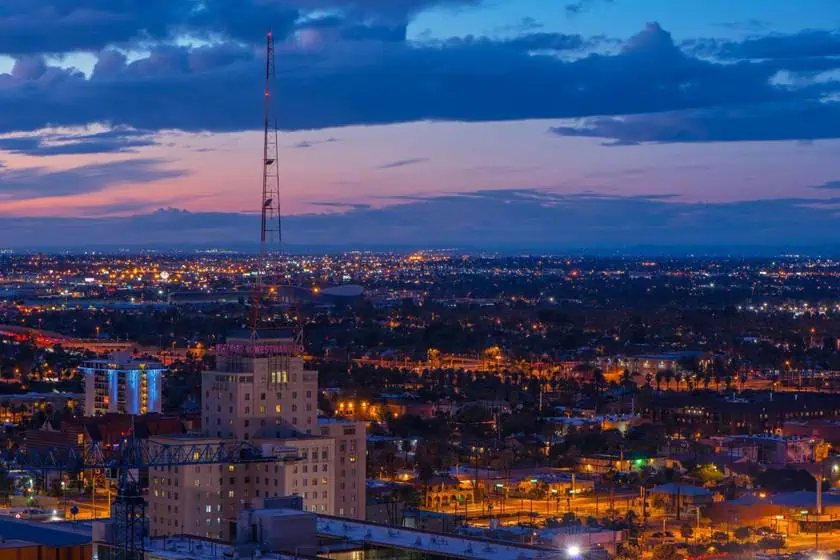
(Photo Credit: Unsplash/DigitalFreePress)
Research supports that mixed land use and higher density reduce driving and improve livability. For example, a study from Arizona’s Department of Transportation found that higher density, mixed-use land patterns in Phoenix could reduce vehicle miles traveled (VMT) by around 25%. Another study (Seo, Golub & Kuby, 2014) showed that proximity to light rail stations positively impacts residential property values in Phoenix, but with diminishing returns farther from transit nodes, suggesting that development must be focused near transit.
These findings show that benefits are greatest when density, mixed uses, and transit service come together, not when just one element is present.
Challenges Phoenix Must Navigate
While the case for denser, more transit-integrated growth is strong, there are obstacles:
- Community Resistance & Perception: New mixed-use development or increased density often meets resistance from existing residents concerned about traffic, character change, or parking.
- Policy & Zoning Restrictions: Many zoning codes still impose single-use areas, require large parking minimums, or restrict building heights.
- Transit Service Gaps: Even along transit corridors, frequency, reliability, and last-mile connectivity often remain insufficient, especially in lower-density suburbs.
- Heat, Climate, & Infrastructure Pressure: In hot climates like Phoenix, outdoor comfort (shade, cooling, landscaping), water management, and reliable infrastructure are essential for mixed-use and pedestrian-friendly communities to be sustainable.
Where Phoenix Could Go Next
To deepen its adoption of density + mixed-use + transit, Phoenix might consider:
- Expanding mixed-use zoning near transit corridors, especially around light rail or high-frequency bus routes.
- Offering incentives (financial or regulatory) for private developers to build mixed use, affordable housing, and invest in pedestrian infrastructure.
- Improving transit frequency and last-mile connections to make transit viable for more people, including in suburbs.
- Updating parking requirements so they don’t overburden developments with unused parking lots that detract from walkability.
- Strengthening public outreach and design guidelines that integrate climate adaptiveness (shade, cooling, stormwater handling) into mixed use communities.
Phoenix stands at a point where its growth trajectory can take two paths: continuing outward sprawl that increases traffic, costs, and environmental burdens, or embracing a more compact, transit-oriented, mixed-use future that offers more sustainable, livable neighborhoods. Learning from other cities and adopting proven policies and design principles could help Phoenix build communities where daily life is easier, more accessible, and less car-dependent.