Sponsored Content | Digital Free Press
On a warm October night last fall, Clayton Liebman was doing what he loved most — playing football under the lights for Notre Dame Prep. A standout sophomore running back, Clayton had already carried the ball dozens of times in that game.
But something wasn’t right.
“He kept saying he was tired,” said his mother, Korine. “That wasn’t like him. He never asked to come out of a game, but after a few minutes of rest, he was ready to go back in.”
Then, in the third quarter, Clayton took a hit to the chest and collapsed on the field. He wasn’t moving his right side. He was convulsing. He was unresponsive.
What followed was a whirlwind of emergency care, a race against time and a community rallying behind one of its own.
Clayton was rushed to HonorHealth Scottsdale Osborn Medical Center, where trauma teams were already mobilized. Kaveh Najafi, DO, surgeon and trauma medical director at the hospital, remembers the urgency.
“We got the call and the whole team was ready, he was the highest-level trauma activation,” Dr. Najafi said. “We had the OR ready, neurosurgery involved and no delays. He went straight from the trauma bay to surgery. Everyone knew what needed to be done.”
Clayton had suffered a brain bleed. Doctors performed a craniotomy, removing part of his skull to relieve pressure. The decision to leave the bone flap off was critical to his survival.
“He wouldn’t have made it without surgery,” Korine said. “They made that really clear.”


Dr. Najafi said Clayton’s case hit close to home for many on the trauma team.
“Many of us have kids around Clayton’s age. My own son plays football,” he said. “It immediately becomes personal. You see yourself in that situation.”
Clayton spent 13 days in the ICU, much of it on a ventilator. His parents never left his side.
“We were in fight-or-flight mode,” Korine said. “You find strength you didn’t know you had.”
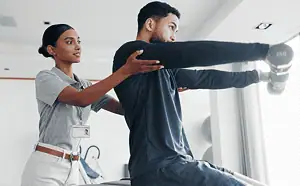
After the ICU, Clayton started a long rehab journey. He couldn’t speak. He couldn’t move his right side. But he could smile — and throw a football with his left hand.
“That was our glimmer of hope,” Korine said. “He’d light up when his teammates visited.”
The community rallied behind Clayton in ways the family never expected. Messages poured in from NFL stars like Larry Fitzgerald and ASU’s Cam Skattebo. The high school held prayer vigils. Students wore “Pray for Clay” bracelets and had signs made. The support was overwhelming.
“It was incredible,” Korine said. “We felt surrounded by love.”
A second surgery in late November replaced the missing piece of his skull. Just days later, Clayton walked across the stage at his team’s banquet to accept the MVP award.
“It wasn’t just because of what happened,” Korine said. “He earned it.”
Now, nearly a year later, Clayton is back at Notre Dame Prep, repeating his sophomore year. He’s not playing football, but he’s still on the field — helping coach and support the junior varsity team.
“It’s a different role,” Clayton said. “I’d love to be out there, but I still get to be around football. That’s all I could ask for. I don’t know if I’ll take it further, but I’ll help out through high school. I love the game.”
Dr. Najafi said Clayton’s recovery is a testament to his grit — and his family’s unwavering support.
“There was never a sliver of doubt from them,” Najafi said. “They were always 100% on his side. That kind of love matters.”
Clayton’s mindset has shifted since the injury. “I’m more optimistic now,” he said. “You only get one life — make the most of it.” He added, “I value life more now. I don’t take things for granted. I’m grateful for every day.”
His recovery continues. He’s working toward driving again, with hopes of getting behind the wheel by his 17th birthday in December.
“I’ve been by his side every day the last eight months at therapy,” Korine said. “It’s not easy to let go as Clayton steps back into normal life, but I thank God every day for how far he has come.”
Clayton’s days are full — school, rehab, football. He’s up early, always in a good mood and focused on the future. He loves math and is looking forward to a career in finance just like his dad.
Dr. Najafi said cases like Clayton’s stay with him.
“There are patients you never forget,” he said. “Clayton’s was one of those. Not just because of the injury, but because of the strength and love surrounding him.”
Clayton’s story is one of grit, grace and gratitude. It’s a reminder of how quickly life can change — and how powerful hope can be.
“I’ve learned to accept what happened and know that God has a bigger plan for me,” Clayton said. “I still love football. I still love life.”